Every company I’ve joined has been at an inflection point.
Sometimes it’s about unlocking scale—Nike needed technology to operate globally in ways that were impossible manually. Sometimes it’s an explicit mandate—Starbucks brought me in to modernize, stabilize, and accelerate. And sometimes the industry itself is shifting, which is how I helped found the Cloud Native Computing Foundation and watched Kubernetes go from experiment to infrastructure standard.
I’m drawn to these moments—but more than that, I’m drawn to helping teams and stakeholders see the path. When you’re inside a transformation, it’s hard to see where you’re going. My job is to make that path clear.
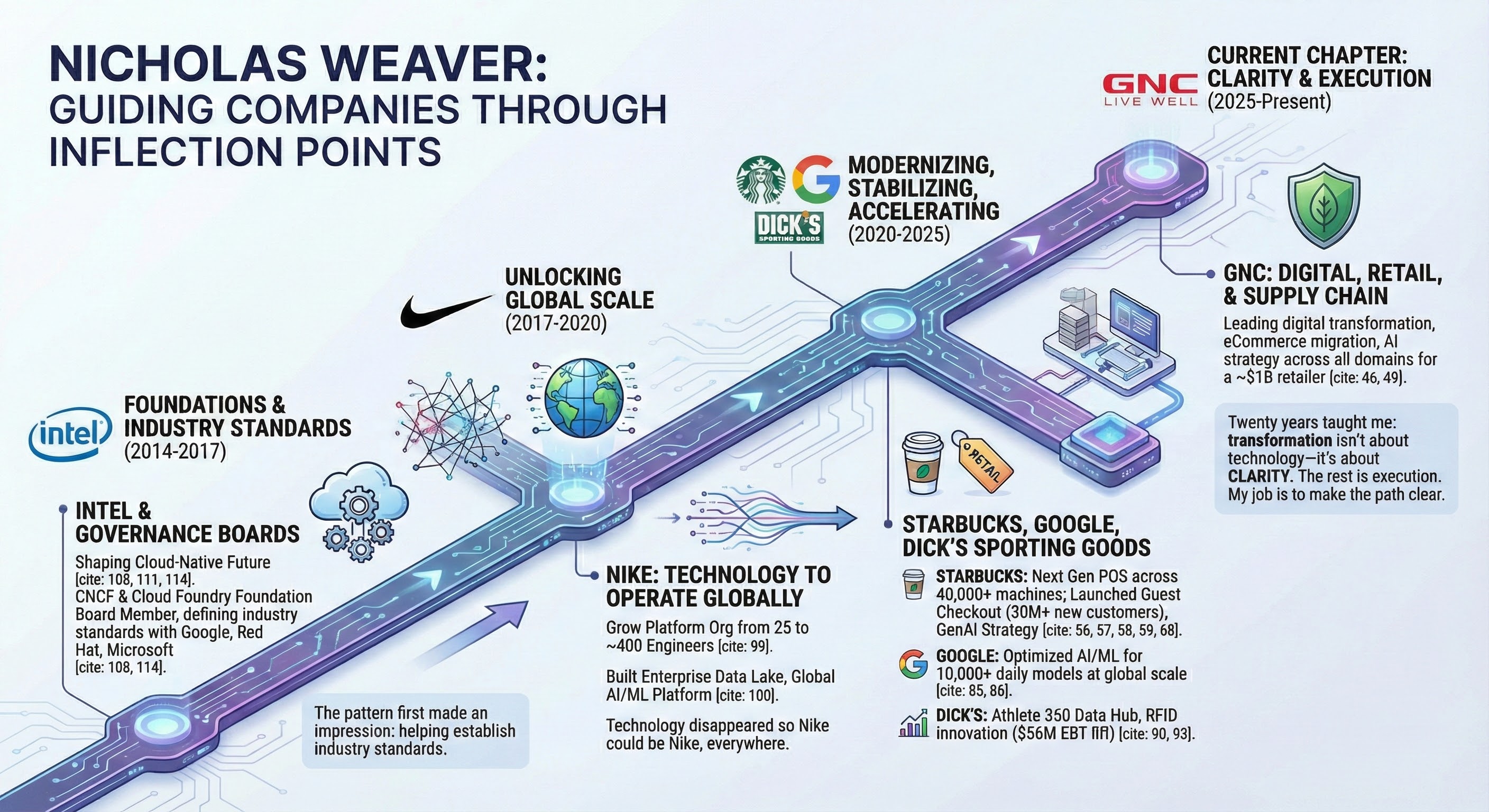
The pattern existed before Intel, but that’s where it first made the biggest impression. Leading engineering teams building cloud-native foundations, I wasn’t just shipping products—I was helping establish what would become the industry standard. I served on the governing boards of both CNCF and Cloud Foundry Foundation, working alongside engineers from Google, Red Hat, and Microsoft to shape how companies would build software for the next decade.
At Nike, I grew the platform organization from 25 to 400 engineers. We built the enterprise data lake, the global AI/ML platform, real-time streaming infrastructure—the invisible machinery that lets a company operate at planetary scale. It wasn’t about Nike becoming a technology company. It was about technology disappearing into the background so Nike could be Nike, everywhere, all at once.
"Nicholas Weaver is a rare example of a deep technologist, industry strategist and people manager. Nicholas has a unique ability to think short and long term about our platform execution strategy in a way that lets employees demonstrate their professional skills and develop new skills. He has wonderful sense of humor in combination with deep empathy that enabled him to lift spirits in stressful situations. His ability to take a complicated topic or strategy and then make it consumable by anyone is unprecedented."
"Rarely do you find an executive with as much technical skill and acumen as Nick. The 3 years that I worked for Nick were the most rewarding of my career. I was particularly impressed by Nick's ability to command a room and get people energized and on board with ideas—even people who were initially on completely different pages."
"I had the pleasure to work with Nicholas for 3 years. During those years Nicholas showed great leadership, friendship, collaboration, and mentorship inside the organization and across Global Technology. His technology depth is extensive with a keen eye to developing, presenting, and delivering strategic vision. Nicholas was able to build and lead a global organization through empowerment, talent development, talent acquisition, and localized decision making."
Google gave me a window into engineering at true global scale—optimizing ML pipelines that touched billions of searches. Dick’s Sporting Goods showed me that enterprise architecture isn’t abstract—it’s about making sure Athletes find what they need, when they need it.
Starbucks brought me in with a clear mandate: modernize, stabilize, accelerate. Their retail technology served 45 million customers a month across 13,000 locations—built on systems running for two decades. We architected the Next Generation POS rollout across 40,000 machines. We launched Guest Checkout—the first time in Starbucks history customers could transact digitally without joining Rewards. We integrated Grubhub, Google Maps, and others to meet customers wherever they already were.
But the real work wasn’t the technology. It was helping hundreds of engineers and stakeholders see how these pieces connected—how modernizing the foundation would unlock speed everywhere else.
"I had the opportunity to work directly for Nick in Retail Technology during a pivotal time as we reshaped the direction of our tech stack for the next decade and beyond. I deeply appreciated Nick's ability to oscillate between being a long-term visionary who challenged the status quo and a grounded leader who protected the team's focus to drive near-term execution. Nick is a strong advocate and coach for high-performing individuals."
"Nick is an exceptional technology leader—deeply knowledgeable, highly collaborative, and laser-focused on delivering results. What stands out most is the breadth and depth of his technical acumen—among the strongest I've seen in any leader. His ability to bridge deep technical insight with strategic vision was instrumental in the success of our initiatives."
"Nick has an incredible ability to read the room—he sees organizational dynamics clearly and helps you anticipate what's coming. His leadership has challenged me to rethink how I approach problems, teams, and partnerships. Nick doesn't just manage—he invests. He takes the time to help you design your org, build a team that complements your strengths, and develop a strategy to deliver real value."
Now I’m at GNC, leading digital, retail, merchandising, and supply chain technology for a company ready for its next chapter. Different industry, same pattern: a company at an inflection point, teams who need to see the path forward, technology that should disappear so the business can thrive.
Twenty years of this has taught me that transformation isn’t really about technology—it’s about clarity. The rest is execution.